
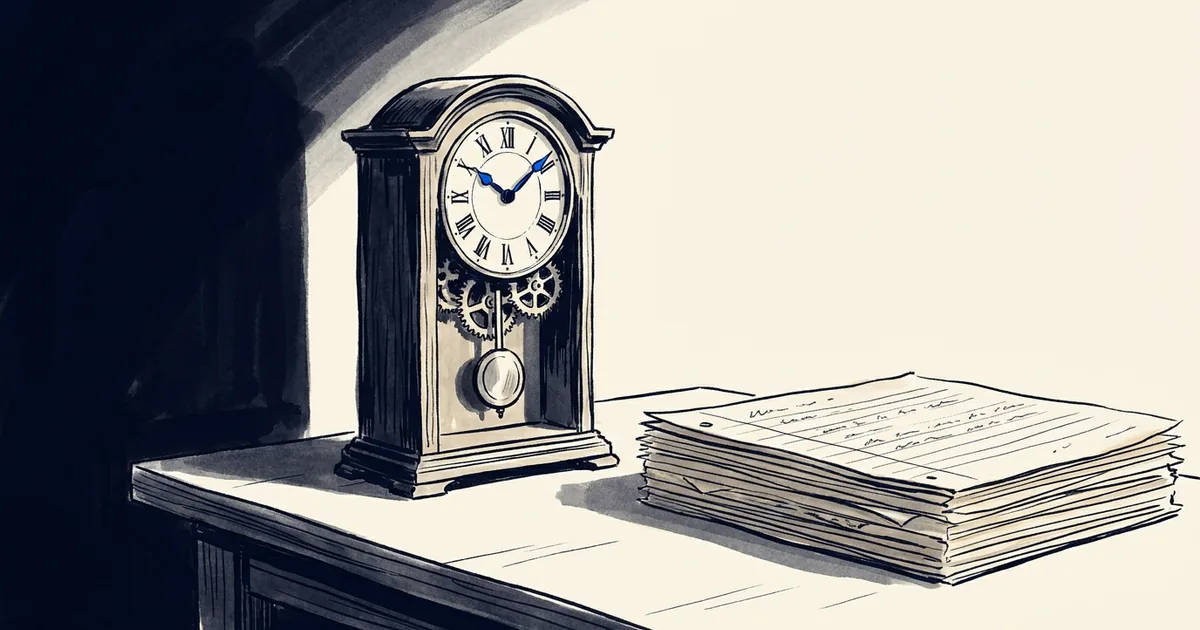
Finding a virtual writing room for novelists gives you the exact structure required to finish your book. When you sit down alongside others at a scheduled hour, a shared timer replaces your reliance on willpower. You focus entirely on your own manuscript while the space holds your momentum steady.
Operating the Shared Clock
The heaviest burden of writing, as we covered in Part 1 and Part 2, is the solitary friction of starting. A virtual writing room for novelists solves this by outsourcing the discipline to a clock. When you know a session starts at a specific minute, the decision of when to begin is made for you. You simply show up.
This is the exact purpose of The November Room. It provides a reliable, structured space where the work gets done alongside other writers. It offers two free 25-minute write-ins a day at 12:00 PM and 8:00 PM New York time. The doors open 10 minutes early so you can settle in, check your notes, and prepare your scene. Once the shared timer begins, you write.
Each writer stays entirely in their own private manuscript. It is free on every plan, requires no credit card, and despite the name, it runs every day through November and after it. This structure works because it removes the negotiation. You are writing for exactly twenty five minutes, because that is what the room is doing.
Evaluating a Proper Space for Novelists
Not every online space is actually built for deep work. Many environments designed for writers accidentally introduce more friction by demanding interaction. A proper room protects your focus above all else. When choosing where to spend your writing hours, look for these specific boundaries.
- A strict schedule. The room should open and close at set times, preventing the illusion that you can arrive whenever you feel like it.
- Absolute privacy for your words. A true workspace ensures you are staying in your own private manuscript, never pasting your work into a shared box.
- A visible, shared timer. The ticking clock is the anchor that replaces your own depleting willpower.
- Zero pressure for chat. The goal is to write a book, not to maintain a conversation.
When these boundaries are in place, the room fades into the background and the manuscript becomes the only thing that matters.
The Anatomy of a Twenty Five Minute Sprint
The twenty five minute block is not arbitrary. It is long enough to establish deep focus and make real progress on a scene, but short enough that it does not trigger mental fatigue. It is a manageable block of time that prevents the dread associated with marathon sessions.
During this time, the only acceptable action is typing. You do not research, you do not edit, and you do not look at other tabs. The brevity of the sprint gives you permission to ignore everything else. You can endure anything for twenty five minutes, including a difficult scene.
When the timer ends, you stop. This built-in stopping point is just as important as the starting point. It leaves you with an unfinished thought, creating a natural starting place for the next session.
Configuring Your Daily Routine
To make this structure work, you have to treat the scheduled hour as a fixed appointment. You cannot treat it as an option. If you plan to attend the evening sprint, you must close your other tabs when the doors open. This ten minute buffer is the transition period your brain needs to leave the daily routine and enter the story world.
This rhythm is the foundation of effective writing sprints. It trains your mind to associate a specific time and a specific visual timer with focused output. Over the course of a few weeks, the resistance to starting drops to near zero.
You stop dreading the blank page because you know you only have to face it for a short burst. When you build your routine around these fixed points, you protect your writing time from the demands of the rest of your life.
Reclaiming the Joy of the Daily Draft
The ultimate goal is to finish your book. When you stop fighting your own willpower and let a shared schedule carry the weight, the joy of drafting returns. You are no longer managing a fragile routine. You are simply showing up, doing the work, and watching the manuscript grow.
The isolation that stalls so many novels is entirely optional. By stepping into a structured room, you reclaim your momentum. You keep your voice sharp, your pacing tight, and your characters alive on the page.
The path from a messy draft to a completed novel is built in focused increments, surrounded by others doing exactly the same thing. You provide the story, and the room provides the structure.
Questions writers ask
What is a virtual writing room?
A virtual writing room is a scheduled online space where authors gather at a specific time to write independently. It uses a shared timer to structure the session, allowing writers to focus on their own private manuscripts without relying entirely on their own willpower.
Do I have to share my work in a writing room?
No. In a properly structured room, you never share your prose. You stay entirely within your own private manuscript. The shared element is the schedule and the timer, not the words you are writing.
Why are sprints usually twenty five minutes?
Twenty five minutes is long enough to establish deep focus and make real progress on a scene, but short enough that it does not trigger mental fatigue. It is a manageable block of time that prevents the dread associated with marathon writing sessions.