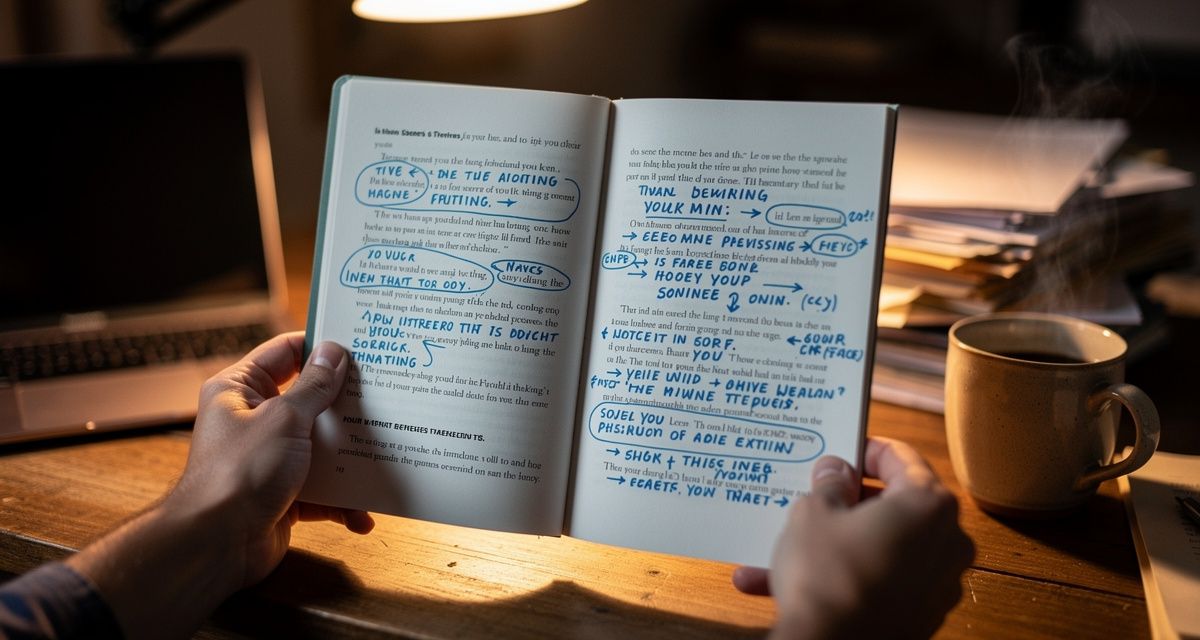

The writers who finish aren't the ones with the cleanest drafts - they're the ones who stop trying to clean them too early.
The writers who finish their novels aren't the ones with the cleanest first drafts. They're the ones who stop trying to clean them too early.
If you've ever stared at 40,000 words that feel like a car crash, you're not failing at structure. You're succeeding at discovery. The scenes don't connect linearly. Characters have evolved past their original arcs. Entire subplots appeared without permission, and your ending now wants to be a completely different book.
The myth says a messy draft means you planned wrong, or that "real writers" somehow bypass this phase entirely. That isn't true. The mess is data. Your draft contains an intelligence you haven't learned to read yet, and the structure you need is already hiding inside the chaos.
Your messy first draft isn't a planning failure - it's an embryonic manuscript with a hidden structure already embedded in the chaos. Writers who finish novels use an archaeological read and reverse outlining to excavate emotional clusters and structural pillars without rewriting from scratch. Most discovery drafts feel unresolvable by the middle, but this is precisely where the draft's true architecture around protagonist desire, opposition, and transformation typically becomes visible.
The messiness of your draft isn't a flaw in your process - it's evidence that your story has outgrown its original container.
Why the Mess Feels Like Failure (But Isn't)
Most writers hit a wall at 60 - 75% completion - precisely when the accumulated 'mess' of discovery writing feels unresolvable. This isn't a coincidence. It's a pattern. At that threshold, you've written enough to reveal the story's true preoccupations, but not enough to see how they connect.
The draft feels broken because you're looking at it through the lens of your original plan instead of the structure that actually emerged on the page. If you're staring at a manuscript that seems broken, you're exactly where you need to be.
| Myth | Reality |
|---|---|
| Good writers produce clean first drafts. | Even detailed outliners produce structural chaos by Act Two because characters evolve during drafting. |
| A messy draft means you should have planned more. | Excessive pre-writing often creates rigid manuscripts that break when the story wants to go elsewhere. |
| If your draft feels unresolvable at 60%, it's doomed. | 60-75% completion is where hidden structure typically emerges; most abandoned manuscripts quit right before the pattern becomes visible. |
Even Outliners Hit the Wall
The idea that good writers produce clean first drafts is a lie that stalls more manuscripts than writer's block. Even detailed outliners hit structural chaos by Act Two because characters refuse to stay inside predetermined boxes. They develop unexpected desires. They react to situations in ways that break your plot.
The outline becomes a fossil while the story grows teeth and demands new territory. This is why pantsing vs plotting isn't the real debate - the debate is whether you trust the chaos enough to keep going.
Excessive pre-writing often makes the problem worse, not better. Rigid manuscripts snap when the narrative wants to bend. Authors who planned for months frequently face the same mid-draft crisis as discovery writers.
The difference isn't the amount of planning. It's the willingness to treat the mess as material instead of mistake. When you stop judging the draft and start reading it archaeologically, the pattern emerges.
The Pattern in the Chaos
Seemingly random first-draft scenes cluster around three structural pillars: protagonist desire, opposition force, or transformation moment. What looks like a scattered plot is often a dense concentration of emotional truth.
The scenes aren't random. They're orbiting something central that you haven't named yet. Observation comes before correction.
You didn't write 40,000 random words. You wrote 40,000 words orbiting a truth you haven't named yet.
Writers who abandon their manuscripts at this stage aren't lacking talent. They're lacking a map and a method. The chaos isn't evidence of a failed process.
It's evidence that your subconscious has outpaced your outline, and the story is finding its real shape underneath the noise. The structure was there all along. You just needed to know how to look.
Every messy draft at 60-75% completion contains a hidden structural logic that looks like failure but is actually the story finding its true shape.
How to Excavate Your Draft's Hidden Structure
You don't need to rebuild your draft. You need to excavate the structure your subconscious already built.
The Archaeological Read
Export your manuscript and read it straight through without editing. Don't fix typos. Don't rewrite dialogue. Don't even touch the keyboard. Read it like a stranger's novel.
Highlight only what surprises you: repetitions, obsessions, images that appear in multiple scenes, and moments that feel out of place. These are not errors. They're signals. Surprise is your compass.
The scene that doesn't fit your outline might be the scene that reveals your protagonist's true desire. The character who showed up uninvited might be carrying the thematic weight you didn't know you needed.
Emotional Clustering
Group scenes by the emotional truth they share rather than by plot order. You might discover that three seemingly disconnected scenes all orbit the protagonist's fear of abandonment, or that your antagonist appears most vividly in moments of unexpected mercy.
The chronological order is a false hierarchy. These clusters reveal the draft's real architecture. They show you what your story is actually about, underneath the plot you thought you were writing. When you arrange scenes by emotional resonance instead of chronology, the spine of your novel becomes visible.
You stop asking "what happens next" and start asking "what truth is being fought for here." This is how first draft organization actually works.
The Reverse Outline
After your cold read, write one sentence summarizing each scene in the order it appears. Not the order it should appear. The order it actually appears.
This reveals the actual structure your intuition built, not the one you planned. Many writers panic at this stage because the reverse outline looks nothing like a three-act diagram. That's the point. Three acts are a checklist, not a discovery.
Your draft has been telling you what it wants to be. The reverse outline simply translates that message into a language you can work with. It turns your mess into a map.
Reverse outlining isn't an admission that you pantsed wrong. It's a method for reading the intelligence already on the page.
The Embryonic Frame
Restarting feels productive, but it erases the subconscious patterns you spent months developing. The writers who make it to the finish line aren't the ones who restarted. They're the ones who stayed with the mess long enough to see it clarify.
You lose the accidental brilliance that only comes from discovery. An embryo doesn't look like a baby, and your first draft isn't supposed to look like a finished novel. The strange shape is temporary.
It contains everything the final form needs. Your job isn't to judge it. Your job is to protect it long enough for the structure to fully emerge.
This is the core of fixing a messy manuscript without destroying it.
You don't need to rebuild your draft; you need to excavate the structure that your subconscious already built.
"But Won't the Mess Just Get Worse?"
Rewriting is a trap that feels like progress. The most common objection is simple: "If I don't rewrite now, the mess will only get worse." Early rewriting erases subconscious patterns before you can identify them. The mess clarifies with distance, not deletion.
When you delete a scene because it doesn't fit your outline, you often delete the very clue that reveals your story's true structure. You are literally destroying evidence at the crime scene of your own novel.
Discovery writers worry that outlining will kill their process. Reverse outlining happens after drafting, not before. It maps what your intuition delivered without imposing a pre-writing structure that can suffocate creative momentum.
You aren't becoming a plotter. You're becoming an archaeologist of your own work. The map follows the territory.
Rewriting too early destroys the evidence. Mapping what you wrote preserves your intuition while giving you direction.
Trust the Chaos
The authors who finish aren't the ones with perfect plans. They're the ones who trust that 60,000 messy words contain a coherent novel waiting to be extracted.
You don't need to be smarter than your draft. You need to be patient enough to let it teach you what it wants to become. The structure isn't missing.
It's buried. And you have the tools to dig it out without destroying what you've built. Perseverance is the only talent that matters at 60%.
An embryo doesn't look like a baby, and your first draft isn't supposed to look like a finished novel.
- Day 1: Export your draft and read it in one sitting without editing.
- Day 2: List the three emotions that appear most often.
- Day 3: Write a one-sentence summary of every scene.
- Day 4: Group scenes by the emotional truth they share.
- Day 5: Identify your protagonist's true desire as it actually appears on the page.
- Day 6: Mark the scenes that show opposition or transformation.
- Day 7: Write a new single-page outline based only on what you found.
Your draft isn't smarter than you because it's perfect - it's smarter because it already knows what your outline didn't.
References
- https://sophie-writes.com/2024/02/16/tip-8-dealing-with-a-messy-first-draft/
- https://patthomson.net/2016/04/25/tackling-a-messy-first-draft/
- https://www.dabblewriter.com/articles/messy-first-drafts
- https://www.writersdigest.com/at-work-on-first-draft/get-messy-with-your-first-draft
- https://bookmama.com/manuscript-consulting/
- https://maryadkinswriter.com/blog/3-act-structure-breakdown