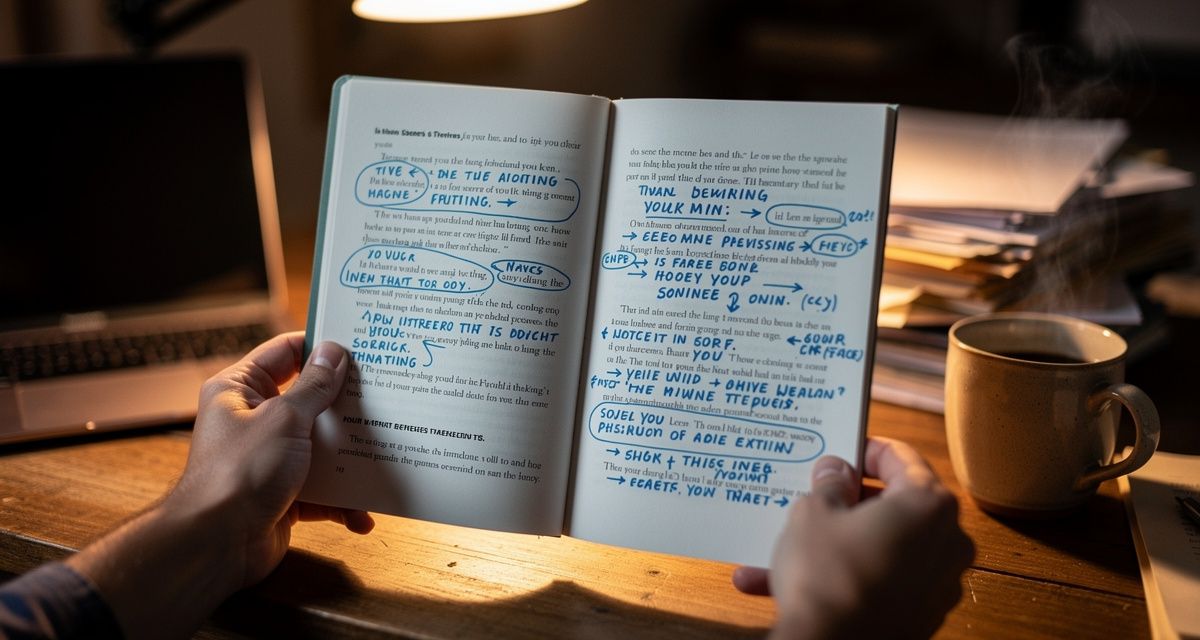

A forward-only protocol for writers trapped in endless revision.
You sit down at 9 p.m., open the chapter you abandoned in March, and an hour later you've rewritten the same opening paragraph four times. The cursor blinks in the same spot. Your word count hasn't moved.
If you want to know how to stop rewriting chapter one, you first have to see the trap clearly. You keep polishing that opening because editing feels safer than moving forward - a case of writer's block perfectionism disguised as craft. The forward-only protocol breaks this cycle by banning backward revision during drafting sessions and using placeholder language to maintain momentum.
This is the central lie of the polish trap: editing feels like progress while it quietly kills your manuscript. You aren't refining your way to a finished novel. You're rehearsing the same thirty pages because moving forward feels dangerous and the middle of your story feels unknown. Meanwhile, the writers who finish their books keep walking past Chapter One.
The forward-only protocol shifts your identity from a writer who fixes to a writer who completes.
Rewriting Chapter One feels like craft, but it's often perfectionism wearing a disguise.
The Polish Trap Hides Zero Forward Motion
Editing delivers visible change. You delete a cliché, tighten a description, swap a name, and the page looks better. That immediate gratification masks a hard truth: your manuscript's total word count hasn't budged, and the story hasn't advanced by a single beat. The opening becomes a treadmill - lots of motion, no destination.
We've seen this pattern repeatedly: authors log version after version of Chapter One while later chapters remain blank. The comfort of the known page wins over the terror of the blank one, and the manuscript stalls invisibly because the writer still shows up every day. The desk is warm, the effort looks real, but the book isn't breathing.
Three warning signs reveal when rewriting has become perfectionism in writing. First, your word count stays flat across sessions even though you "wrote" for an hour. Second, you feel relief rather than momentum when you close your laptop. Third, you keep telling yourself you'll move forward once Chapter One is "right" - a standard that shifts every time you reread it.
The real driver isn't lack of ideas. It's emotional friction. You have the idea. You have the time blocked. But when the session starts, the weight of creating something imperfect pulls you backward into the safety of what already exists. You open the document to write Chapter Two and find yourself "fixing" Chapter One instead. The manuscript never grows, but your anxiety about it does.
The psychology behind this is simple. First draft fear and perfectionism create a safety loop that feels like craft. Chapter One is familiar territory. Chapter Four is a wilderness where your plot might collapse and your characters might flatline. Your brain chooses the task it can control - polishing a sentence until it gleams - over the task that actually matters: advancing into uncertainty. Writers who obsessively rewrite early chapters are far more likely to abandon their manuscript entirely. The loop doesn't just slow you down; it predicts failure. The cruelest part is that every rewrite convinces you you're working hard while your book dies in place.
- Have you rewritten your opening chapter more than three times?
- Do you feel safer editing yesterday's work than writing new scenes?
- Has your manuscript's word count stayed flat for two weeks or more?
- Do you tell yourself you'll move forward once this chapter is 'right'?
- Do you feel a sense of relief rather than momentum after a writing session?
Editing feels like progress because it produces visible change. Writing new words feels like risk because it might not work.
The polish trap rewards you with visible change while hiding the fact that your manuscript isn't moving forward.
The Forward-Only Protocol: A One-Way Street
The fix is structural. You need a rule set that makes backward revision impossible and helps you stop editing while writing.
The forward-only protocol treats every session as a one-way street. The goal isn't beautiful prose. It's to finish first draft and give yourself something to revise.
Rule 1: Start cold. Open your manuscript at the end of your last scene. Do not read Chapter One. Do not skim yesterday's paragraphs. Reading invites tweaking; tweaking invites rewriting; rewriting kills forward motion.
Place your cursor where the story stopped and begin. If you need context, jot a three-sentence summary in your fix list, then write the next beat.
Rule 2: Use placeholder language. When you hit a name you can't settle on, type [NAME - sharp, starts with K?] and keep moving. When a description feels flat, write [DESCRIBE - the smell of rain on hot pavement] and push forward. Placeholder language holds space for later craft. You are building the skeleton now; the muscle comes in revision.
Rule 3: Maintain a fix list. Keep a separate document open beside your manuscript. When you spot a problem, log it instead of repairing it. "Chapter 3 - fix age discrepancy" takes ten seconds and keeps your drafting session intact. The fix list acknowledges the problem without demanding immediate surgery.
The fix list also reveals patterns. You might notice you flag "description too thin" repeatedly. That's a revision-phase problem, not a drafting-phase problem. Seeing it listed five times tells you what to tackle once the draft is done, but frees you from solving it now.
The psychological shift runs deeper than the rules. Stop identifying as a writer who fixes and start identifying as a writer who completes. The first draft is raw material to be generated, not a product to be perfected. Accepting that some sentences will be ugly and some scenes thin until the final page is written is the price of completion.
Many aspiring authors believe this produces an unsalvageable mess. The opposite is true. A complete messy draft contains the structural DNA of your novel - character arcs, plot turns, emotional rhythms. A perfect first chapter with no Chapter Two contains nothing you can use.
We've watched authors move from stalled manuscripts to completed drafts by changing one behavior: they stopped scrolling up. The writers who finish aren't necessarily more talented. They've simply made backward motion impossible.
| Before | After |
|---|---|
| Open manuscript, reread Chapter One, tweak three sentences, delete a paragraph, zero new words. | Open blank continuation, write next scene with bracketed placeholder, add 400 new words. |
| Stuck on a character name for 20 minutes. | Type [NAME - sharp, K?] and keep writing. |
| Word count flat for two weeks. | Word count advances 400 - 800 words per session because backward movement is blocked. |
Your first draft isn't broken. Your standard for it is.
The forward-only protocol treats every writing session as a one-way street: new words in, no editing out.
Your First Week on the Protocol
You don't need to overhaul your entire process. You need four concrete changes that make backward revision harder than forward motion.
Step 1: Impose a 48-hour ban on opening Chapter One. Write only new material. If you must reference earlier events, use your fix list or a scratch pad. Do not scroll up. The two-day window is short enough to feel manageable and long enough to break the reflex of rereading.
Step 2: Create your personal placeholder shorthand. Pick three brackets you'll use consistently: [NAME], [DESCRIBE], [CHECK]. When you hit a block, insert the bracket and move on. The decision to defer is itself a decision that keeps the book alive.
Step 3: Build the fix-list habit to stop editing while writing. Keep a separate document open during every session. When the editing urge strikes - and it will - type the issue into the fix list instead of the manuscript. The urge passes faster when it has somewhere to land. By Friday, your fix list will hold a clear revision roadmap, and your manuscript will hold new chapters.
Step 4: Track progress by net new words per session, not by how polished Chapter One feels. Aim for 400 to 800 new words. If you hit a bracket every hundred words, you're still advancing. The number that matters is the distance between where you started today and where you stopped.
Placeholder language isn't lazy writing. It's a structural choice that preserves momentum.
Placeholder language and bracketed notes keep your story moving without forcing perfect prose in the moment.
The Scene That Wouldn't End
The scene that wouldn't end is not a craft problem. It is a symptom of backward-facing perfectionism. You keep returning to Chapter One because it feels safer than facing the unknown territory ahead, and because finishing means showing your work to the world.
The real work of a novelist is generating raw material. Revision is a separate job with a separate mindset, separate tools, and a separate timeline. You cannot do both at once without sacrificing one, and the one that always loses is completion. Your future self - the one with a complete draft - will have plenty of time to edit. But that future self only arrives if you stop fixing now.
Chapter One does not need to be perfect. It needs to be done so that Chapter Two can exist, and Chapter Ten, and the final page. If you want to finish, you have to learn how to stop rewriting chapter one and start trusting the forward motion. The writers who finish their books aren't the ones with the cleanest opening paragraphs. They're the ones who learned to walk forward without looking back until the story was fully told.
Finishing a novel requires shifting your identity from a writer who fixes to a writer who completes.
References
- https://writersblockmagazine.com/2026/04/04/writers-write-rethinking-and-overcoming-writers-block/
- https://www.psychologytoday.com/us/blog/creating-in-flow/201402/5-ways-to-finish-what-you-start-and-why-you-often-dont
- https://www.writercosmos.com/blog/overcome-writing-procrastination-2026/
- https://www.capturingyourconfidence.com/blog/stop-unnecessary-rewriting
- https://goteenwriters.com/2023/11/01/4-ideas-to-help-you-get-over-obsessively-rewriting-chapter-one/
- https://aprildavila.com/stop-rewriting-start-finishing/