
A sustainable daily writing routine relies on focused 90-minute sessions, stopping mid-sentence to make the next day's start frictionless, and isolating administrative tasks to low-energy hours. True productivity for authors is about creating a predictable container for the work, rather than enforcing rigid daily word counts.
The Morning Reality of a Daily Writing Routine
People always ask me how I manage to write consistently while juggling the rest of life. The truth? It is messy, imperfect, and nothing like those perfectly curated videos you see online.
I wake up at 6:15 AM. Not because I am some naturally disciplined morning person, but because that is the only time my house is completely quiet and my brain is rested. I stumble to the kitchen, make a highly average cup of coffee—I gave up on becoming a coffee snob years ago—and sit down with a physical notebook.
I spend the first fifteen minutes doing a pure brain dump. I scribble down whatever cognitive static is cluttering my mind: worries about deadlines, stray thoughts about a plot hole I noticed yesterday, the grocery list, or the strange dream I just had. Getting all of that noise out on paper clears the necessary space for the actual work of writing a book.
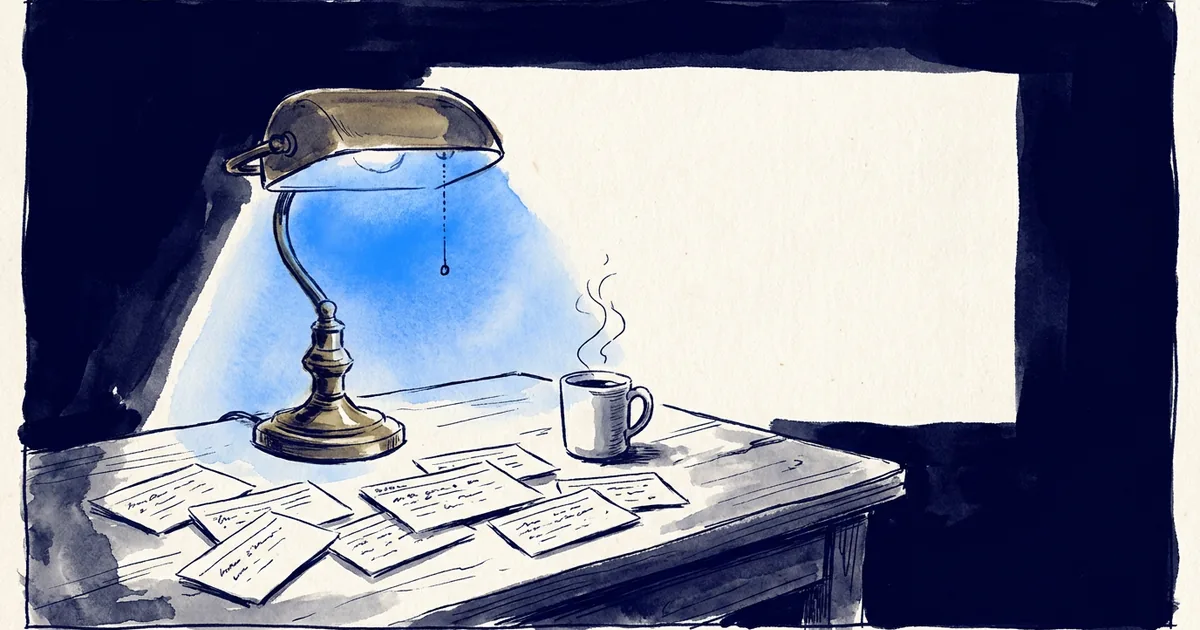
By 7:00 AM, I am at my writing desk. I absolutely do not check email. I do not open a single social media feed. I learned this the hard way: once you open that door to the outside world, your focus is shattered for the rest of the morning. Instead, I open my manuscript and read the last paragraph I wrote the day before. The easiest way to avoid the terror of a blank page is to stop mid-sentence at the end of yesterday's session. When I sit down, I am not starting from scratch; I am simply finishing a thought. It pulls me right back into the story world.
Structuring 90-Minute Writing Sessions
I work in 90-minute blocks. This is significantly longer than the standard 25-minute Pomodoro technique, but the reality of writing a novel is that context switching is expensive. It takes me at least twenty minutes just to sink into a flow state. Those short sprints never worked for me because the moment I finally grasped the thread of the narrative, an alarm would tell me to stop.
During these 90-minute blocks, my phone physically goes into another room. I use website blockers to lock myself out of the internet entirely. It might sound extreme, but the urge to look up a quick historical fact or check a character name is the quickest way to lose a drafting session.
Here is something nobody talks about when they discuss their writing routines: I write terrible first drafts. Genuinely awful, clunky prose. My true productivity trick is not writing brilliant sentences faster; it is giving myself permission to write badly just to keep the momentum going. I have a section in my workspace dedicated entirely to rough material where anything goes. No backspacing, no second-guessing the dialogue, just forward motion. The real progress happens during the editing phase, not in getting every sentence perfect on the first pass.
Momentum matters more than quality in a first draft. Give yourself permission to write terrible sentences so you do not stall out before the chapter is finished.
Handling the Afternoon Slump with Brainless Tasks
Around 2:00 PM, my cognitive energy plummets. I used to fight this, drinking more coffee and staring angrily at my screen while typing absolutely nothing. Now, I lean into it. This is when I handle the logistics of being an author.
I keep a running list called "Brainless Tasks" for exactly these low-energy moments. It includes formatting chapters, organizing world-building notes, updating character sheets, and responding to industry emails. Separating drafting from administration is one of the simplest ways to write faster, because you stop demanding creativity when your brain only has the capacity for logistics. It keeps the project moving forward without burning out my imagination.
I also force myself to take a real lunch break away from screens. I walk outside for at least twenty minutes. Walking away from the manuscript feels counterproductive when you are staring down a deadline, but I have relentlessly tracked my output. On the days I skip the walk and eat at my desk, I produce significantly fewer words in my evening session. Your brain requires physical space to untangle plot problems.
The Evening Wrap-Up and Tomorrow's Priorities
My final writing session runs from 7:00 PM to 8:30 PM. I am gentler with my expectations during this block. If the words come easily, I draft new scenes. If the tank is completely empty, I switch gears and begin revising what I wrote during the morning session.
I have learned that a sustainable routine is not about squeezing every drop of energy from your mind until you crash. It is about showing up consistently and knowing the difference between a moment that requires a firm push and a moment that requires you to coast.
Before I close my computer for the night, I perform the most critical step of my entire routine. I write tomorrow's three priorities on a physical sticky note and place it directly on my keyboard. Just three things. Not a massive, sprawling to-do list that induces panic before I even sit down with my morning coffee. When 7:00 AM rolls around the next day, I do exactly what is on the note.
Why Perfect Daily Consistency is a Myth
Want to know the ultimate productivity secret? I stopped trying to be perfectly productive every single day. Some days I easily draft three thousand words and feel like a seasoned professional. Other days, I struggle to string together three hundred words, and every single sentence feels like lifting heavy stones.
What matters is that the container exists. The routine is not a guaranteed formula for perfect prose; it is a reliable structure that catches your creativity when it is flowing and supports you when it is completely absent.
The routine is not a guaranteed formula for perfect prose; it is a reliable structure that catches your creativity when it is flowing and supports you when it is completely absent.
There are no miracle morning routines or secret applications that will do the work for you. There is only the habit of showing up, doing the work, and being ruthlessly honest with yourself about what actually moves the manuscript forward versus what simply looks impressive to other people.
Questions writers ask
How long should a daily writing routine be?
A daily writing routine should be built around the time you can reliably protect, not an idealized target. For many working authors, one focused 90-minute block yields more usable pages than three fragmented hours. Consistency and focus matter far more than daily duration.
Should I write in the morning or at night?
Write during your peak cognitive window, which varies entirely by person. If your brain is sharpest at 6:00 AM, guard that time for drafting and leave the evening for outlining or research. Fighting your natural energy cycle usually results in deep frustration and lower word counts.
How do I maintain my routine when I hit writer's block?
When you feel stuck, lower the barrier to entry. Give yourself permission to write a terrible draft, switch to a low-stakes administrative task related to your book, or simply outline the next scene. The goal is to keep the appointment with your manuscript, even if the output is messy.